

On 22 October, our Managing Director Stuart Snowden presented an online briefing for Major Events International on the planning and information gap in international event delivery.
The session looked at why problems keep appearing at major events even when every organisation involved is competent and doing its job, what those problems cost, and what can be done about them. The full recording is below.
Chapters in the recording:
A major event brings together the rights holder, the organising committee, the host city, sponsors and suppliers. Each has its own board, its own systems and its own plans. Every time another organisation is added, the lines of communication increase much faster than the number of organisations. Inside a large organising committee there can be more than 30 functional areas before anyone external is involved.
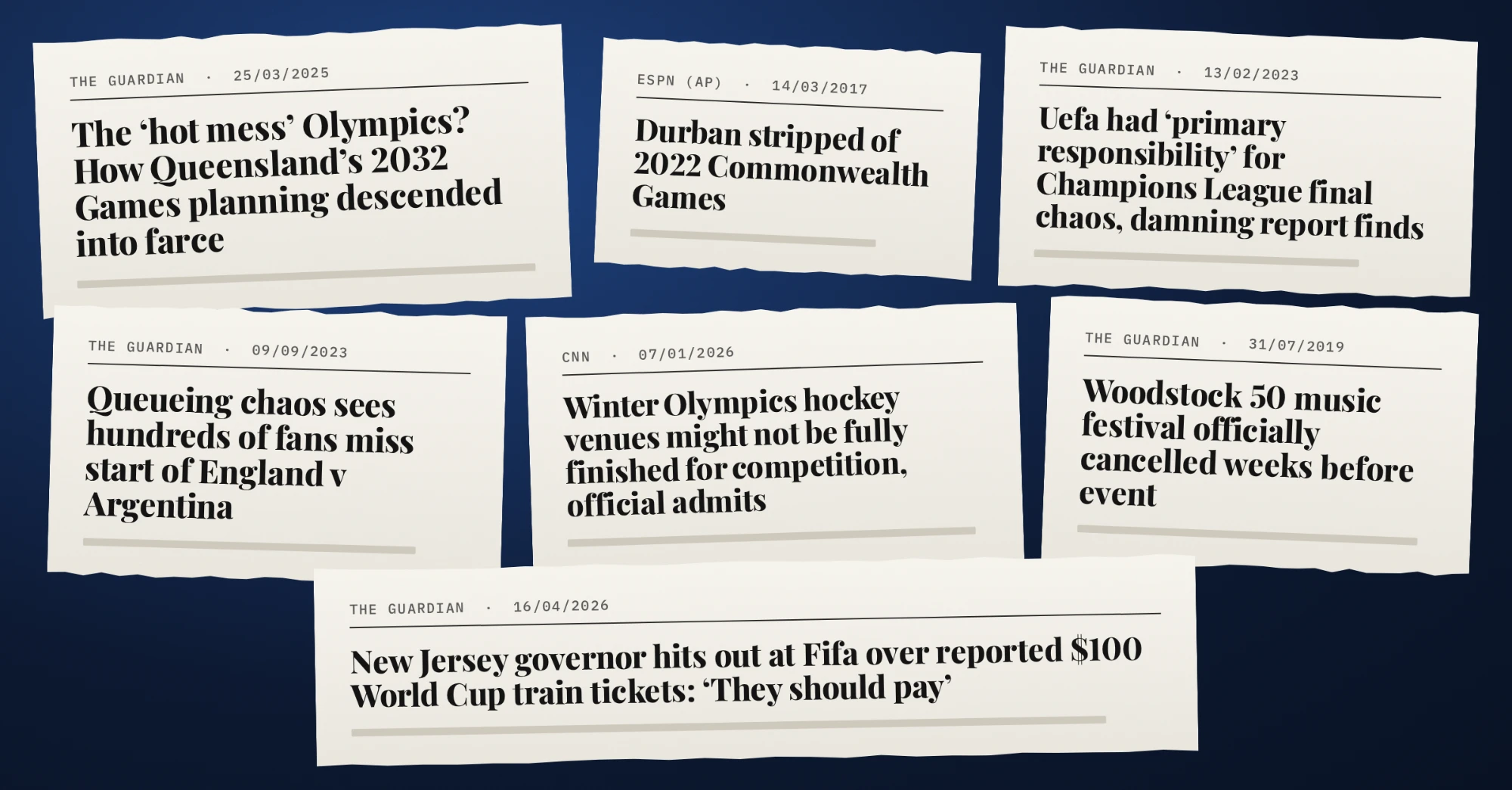
Stuart used the 2022 Champions League final in Paris as an example. The independent review found there was no overall control of safety and security, and real-time information was not shared between the organisations involved. Afterwards the venue, UEFA and the spectators were each blamed at different points. The review said UEFA should have been at the centre, overseeing the whole operation.
When information is passed from one organisation to the next, it often changes along the way. Stuart's example was a figure of 2,400 athletes. Does that mean 2,400 people need transport every day, or do they arrive on different days? If an accreditation number is quoted, does it include media and day passes? Each organisation answers those questions in its own way and plans around its own answer.
This is what the session meant by "multiple versions of the truth". When everyone takes their figures from one central source, those differences don't arise in the first place.
Stuart described an exercise we sometimes run with clients. We ask a manager to draw on a whiteboard how a process works, then ask the person who actually does the work to draw it, and then the person who covers for them when they're away. The three drawings rarely match.
If the way something gets done sits in one person's head, the organisation has a single point of failure. He asked the audience to think about which activities would be at risk if a key person left tomorrow, and how long it would take to work out how to carry on.
Cost is usually measured in money. Stuart argued that it should also be counted in time, reputation, the effect on local communities, the people competing, suppliers' businesses, and legal and regulatory exposure. A late change to a start time can leave athletes competing in conditions they didn't prepare for. Road closures can stop local shops from restocking. After some events, suppliers have gone unpaid and smaller companies have gone out of business.
We ran a short poll during the session. Of the common problems, the one the audience had experienced most often was coordination and admin taking up too much time. Stuart's view is that this is usually where the other problems end up, in time spent chasing, checking and re-entering information.
Someone always asks whether AI can solve this. Stuart's view is that AI can only work with what it is given. If the same information is held in eight different spreadsheets, it has no reliable way of knowing which one is correct. There is also the question of accountability. If a decision is reviewed later, you need to be able to show how it was reached.
His advice was to get the people, processes and information flows right first, and to bring in technology, including AI, after that.
One of the audience questions was who should be responsible for a single-source-of-truth. Stuart said that for a one-off event it should sit with the main event organiser. For an event held repeatedly, the rights holder should hold it and pass day-to-day responsibility to each organising committee, so that what is learned isn't lost when the committee is wound up.
Watch the question and answer (31:11)
Stuart finished with five questions for people to ask about their own events:
Our Time Dividend calculator estimates how much time your team spends on internal admin, providing information, double handling and reporting, and what that costs over a year. You can find it on our Business Performance Improvement page. If any of this sounds familiar, please get in touch.
Thank you to Major Events International for hosting the briefing, and to everyone who joined and asked questions.